


Magazine
From Data Fabric to Patient Impact: Reimagining India’s Healthcare Through AI and Local Innovation
From Data Fabric to Patient Impact: Reimagining India’s Healthcare Through AI and Local Innovation
![]() By Dr. Asawari Savant, eHealth Network - 07 August 2025
By Dr. Asawari Savant, eHealth Network - 07 August 2025


“AI is Like Fabric: You must tailor it into a dress.
Just because the fabric is good doesn’t mean the final dress will be.”
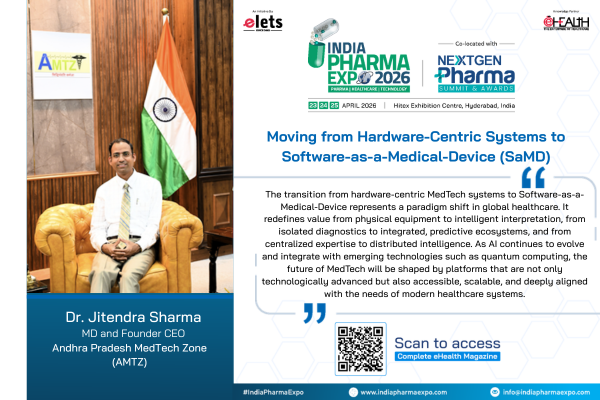
–Dr. Jitendra Sharma, Managing Director & Founder CEO, Andhra Pradesh MedTech Zone (AMTZ)

After spending decades working across both government and private healthcare systems, as a trained hospital administrator, I have come to realise something rather unique: Healthcare is perhaps the funniest business in town. And not “funny” in a humorous way, but in how paradoxically we operate.
Let me explain.
The Healthcare Paradox: Paying for Logistics Without Consumption
No business functions without logistics. That’s a universal rule.
In most industries, such as retail, aviation, and manufacturing, you pay for logistics only when the product is consumed.
In healthcare, that logic collapses.
Imagine an orthopaedic surgery setup. A tray with 20 implants arrives. The surgeon uses just one, because no one can predict the exact size required until the incision is made. The other 19 are returned. Yet someone has paid for the logistics of the entire tray. The cost of unused items is absorbed in the price of the one implant used. Only in healthcare do we pay for logistics without consumption.
Here’s another example.
Take radioisotopes used in PET-CT scans for cancer. These isotopes decay quickly, with a half-life of just 6.5 hours. So, if the distance between the production site and hospital is greater, we need to ship more isotope to compensate for decay en route. You end up paying more for slower delivery, completely opposite from how logistics work in any other industry.
Try telling someone a flight to Delhi will cost more because it takes five hours instead of two. They’ll laugh. But in healthcare, that’s a reality.
AI in Healthcare: Why Application Matters More Than the Product
That’s why this conversation on Artificial Intelligence (AI) is so crucial and delicate. Most of the AI tools being pitched to us come wrapped in sleek presentations, created by people who’ve never faced an angry patient or lost a night’s sleep worrying about a single ICU bed.
We, in healthcare, are a crazy breed. We don’t clock out at 6 PM. Our lives and, more importantly, our patients’ lives, don’t run on Excel sheets. Mistakes in other industries might lead to losses; in ours, they can be irreversible.
Still, we show up every day, neatly dressed, composed, calm. That’s why I say: medical professionals are angels. Whether you’re a nurse, administrator, surgeon, or ward boy, you carry chaos in your head and peace on your face.
A Framework for Judging AI in Healthcare
So, how do we decide which AI tools are worth our time? I’ve distilled it down to four principles—simple, but effective.
1. Know Where It Fits
Any innovation must fall into one of four healthcare baskets:
- Infrastructure (e.g., temperature control, pneumatic tubes)
- Medical technology (e.g., MRI, OT sterilisers, lab analysers)
- Prescription and Patient Care (e.g., AI detecting drug errors)
- Processes (e.g., ER staffing based on accident trends)
AI is like fabric—it’s only valuable when tailored. Without tailoring, even the most expensive fabric is useless.
2. Know Its Origin
Ask: What is the AI product based on?
- Is it a database (e.g., thousands of cataract images)?
- Is it an algorithm, quietly doing its job behind a UI?
- Or is it a large language model, evolving constantly?
Also, consider infrastructure. Back in 2005, servers consumed 4 kW per rack. In 2015, it was 20 kW. Today, with AI, we’re at 80 kW per rack. Data centres are overheating. We must evaluate whether our systems are even ready to handle these tools.
3. Let Application Define Product
The product should serve a specific need, not the other way around. We classify applications into:
- DX (Diagnostics) – e.g., D-Dimer flags for clot risk
- RX (Prescription) – e.g., anticipating drug changes
- PX (Process) – e.g., avoiding inefficiencies like performing breast cancer biopsies before mammography (which happens over 70,000 times a year in India)
Why try on a second shirt after you’ve already bought one? That’s what mammography after biopsy is like.
4. Make It in India
Let me be blunt—India imports 98% of its medical technology. We spend ₹64,000 crore every year on foreign equipment. You can ride a “Make in India” train, but you can’t find a “Made in India” hospital.
So on January 3, 2018, we began building AMTZ (Andhra Pradesh MedTech Zone) in Visakhapatnam. Back then, it was a jungle. No roads, no network, not even a PIN code.
Today, it is the world’s largest med-tech park:
- 158 factories
- 22 GoI institutions
- 7,000+ engineers, scientists, and professionals
We manufacture everything—masks, multiparameter monitors, oxygen concentrators, CTs, and MRIs. The same MRI I used to import for ₹6 crore, I now export for ₹2.8 crore. During COVID, we supplied 11 lakh RT-PCR kits daily.
Next Frontiers: Made in India Hospitals and Quantum Computing
We’re now building Made in India hospitals, which are equipped 100% with Indian equipment, cutting costs by nearly half.
And we’re not stopping there. We’re setting up a Healthcare Quantum Computing Centre, because that’s where the next leap will come from.
Also read: Expanding Care Beyond Metros: Tech-Driven Solutions for India’s Infertility Care Crisis
A Call for Collaborative, Contextual Innovation
AI in healthcare is not a “plug-and-play” solution. It must be contextual, clinical, and carefully integrated. My only request: before you adopt any technology, ask if it fits into your workflow, your infrastructure, your ethics, and your chaos.
If you’d like to partner with us, be it on manufacturing, AI deployment, clinical validation, or training, we’re open. Come to AMTZ in Visakhapatnam. See what we’ve built together, and what we can build next.
Just type into ChatGPT: “Which is the most happening medical technology park in India?” The answer is already there.
Views expressed by Dr. Jitendra Sharma, Managing Director & Founder CEO, Andhra Pradesh MedTech Zone (AMTZ), in a compelling address delivered at the 15th Elets Healthcare Innovation Summit & Awards in Mumbai.
Click here to watch the entire talk: https://drive.google.com/file/d/1N2OS4zxqYxabjcKvm6NRVrUK_9K_5ju0/view?usp=sharing

 Like
Like
 Dislike
Be a part of Elets Collaborative Initiatives. Join Us for Upcoming Events and explore business opportunities. Like us on Facebook , connect with us on LinkedIn and follow us on Twitter , Instagram.
"Exciting news! Elets technomedia is now on WhatsApp Channels Subscribe today by clicking the link and stay updated with the latest insights!" Click here!